 An hour or so away by plane from NAIA, all of 8 to 9 hours travel by road. Take your pick.
We chose to fly, then rent a car from our base which is Fort Ilocandia Hotel and Resort. The hotel is a good base for many day trips to various parts of the Ilocos Region. Top of the list is a visit to Vigan, the only surviving colonial town in the country. Declared a UNESCO Heritage Site, it is a must see for all visitors who want to catch a glimpse of how it was in the 18th and early 19th century. Time stood still in this part of Northern Philippines. It helped too that Vigan , unlike Cebu and Manila, was spared of the bombing last World War II. Do not forget that Manila is the second most bombed city during that war. By God's mercy, Vigan survived and preserved its antiquated houses, cobbled pathways, even the calesas or horse-drawn carts. The township with all its narrow streets speak of an architecture which blends Spanish, Asian and Mexican influences. At the time, it was called Ciudad Fernandina before it became Vigan which comes from the word "kabiga-an" where a tuberous plant called "biga" abounds. Then famous as a commercial and trading post, it attracted Chinese junks sailing from the South China Sea. Some of these Chinese seafarers married natives and settled in Vigan. This was long before King Philip II of Spain sent Captain Juan de Salcedo who then "founded" the town in 1572 and called it Ciudad Fernandina in honor of the King's son Ferdinand who died at an early age. Since then, Augustinian missionaries visited Vigan and the rest of Ilocos Region and initiated the evangelization of the area. Many churches and monuments still stand today, spared from the bombings of World War II.

Back in Laoag, Ilocos Norte, we spent the next day visiting Paoay Church, another UNESCO Heritage Site. I have not seen a church compound anywhere in the Philippines as grand as this one. Paoay Church stands proud. It is by no means as grand as the churches you'd find in Europe, but the colonial heritage and the Spanish legacy give it its well-deserved grandeur. Built of bricks and coral blocks, the architecture combines Gothic, Baroque and Oriental. Built over a
 period of nearly 200 years, the church belltower is a fitting reminder of the Christianization of the Philippines as ell as its role in the Philippine Revolution when it was used as an observation post by the local rebels called Katipuneros. Another church , the St. William's Church, was built by the Augustinian frailes or priests in 1612 in the Italian Renaissance design. Right next to it is a sunken belltower leaning slightly to the North. This is our local though much scaled-down version of the Pisa tower. A 3rd church we visited was Sta. Monica Church , a century old church of neo-classical and baroque architecture.
 Of more recent history is the fact that ex-President and strongman Ferdinand Marcos hails from Batac, not too far from Laoag. The ancestral house of the Marcoses is now the Marcos Museum and Mausoleoum where the late President's body lies like a wax statue. During his 20 year reign, Marcos built a Malacanang of the North (Malacanang in Manila is the official residence of the President, much like the White House in Washington DC). The mansion is an expression of opulence and overlooks the lovely Paoay Lake. Now a museum, visitors can tour the mansion for a minimal fee.
These days, the Ilocos Region is still considered Marcos land despite the fact that the dictator has passed on many years ago. His only son, Ferdinand Junior, Bongbong to most, is the current congressman representing the Ilocos Region. Bongbong earlier served as governor of the province, during which time the Bangui Windmills were established. This wind farm lies nearly next to Pagudpud and now has 15 wind turbines. It has since attracted many visitors to the area just to view the 70 meters tall wind turbines. And not too far from here is the Cape Bojeador , a lighthouse built in 1892 north of Laoag City. It is the highest, and I think the oldest, lighthouse in the country.

Many Ilocanos to this day idolize the late President Marcos. Without dwelling on politics, I will venture to suggest that the more prominent and admirable Ilocanos should be Juan Luna , Diego Silang and his equally brave widow, Gabriela. All three are martyrs and heroes of the land. They have done far more for our country than any other Ilocano. That said, let me invite everyone to visit our land!


 1. First, on your arrival in Manila, book a decent budget accommodation in the heart of the City but close to the airport. Then, take The RORO system to Boracay which is fast becoming the preferred mode of transpo for people who would like to explore the different islands of the Philippines, Boracay included. The Nautical "Highway" is a combination of overland highways and roll-on, roll-off (RoRo) vessels that allow you to bring vehicle to Panay Island and visit key cities like Kalibo. However, one cannot ferry a car to Boracay Island.


 As a child, my ears got so used to many old folks' stories about Taal Volcano where one finds a lake within a volcano within a lake within a volcano. Yeah, I know, it sounds redundant. Can you imagine me listening to all these stories and this line which has now become an adjective to describe Taal Volcano back when I was still of pre-school age? It appears Taal Volcano made up for its size by always threatening to erupt, as if drawing attention
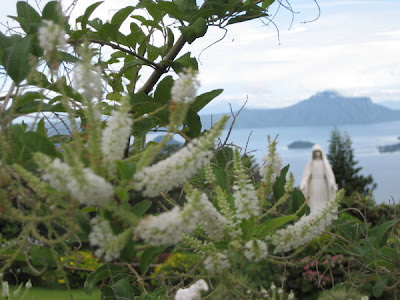 The story goes that Tagaytay Ridge where one gets a perfect view of Taal Lake and Volcano was actually part of a bigger volcano until a major eruption hundreds or thousands of years ago. Originally a huge volcano towering 18,000 feet, many people don't realize that it used to be one of the largest volcanoes in the world. Tagaytay Ridge is the rim of the volcano! Before it was "reduced" to its present size, Tagaytay ridge would have been only about a sixth of the way to the top of the volcano!! This caldera is now fringed with many tourist inns, hotels, restaurants and picnic groves. A major golf course (Tagaytay Highlands) and a casino (near Taal Vista Lodge Hotel) can also be found along this ridge. Most tourists make day trips from Manila to this place, missing out on an unhurried day of adventure which may include a boat journey through the lake to reach the volcano island (about 1,500 pesos or US $30 for the entire boat so you can split it among the 3 or 4 of you), a trek to the top of the volcano on a donkey (most recommended, unless you are very very fit but be ready to shed another US$20 per person), as well as trying out the many fine-dining and local restaurants in the area.
 Many years back when Tagaytay only had picnic huts available for rent to locals bringing in their own picnic baskets, the place was famous for its many retreat houses and prayer centers. The cool climate and the now-lost "rustic innocence" of the place made for a very meaningful weekend of prayers and meditation. The retreat houses are still there. And many retreat weekends are still held there. The popularity of the place has also resulted in many foreigners deciding to stay permanently and setting up their own restaurants and shops there. These days, one can make trips to Tagaytay to try out this new Vietnamese restaurant (Bawai), or this Austrian-German bistro called Chateau Hestia, a greek taverna, or a lovely garden restaurant called Moon Garden run by a Belgian.
  Taal
Taal There is always something to do in Tagaytay other than just taking in the view. The more adventurous go for the boat ride and donkey trek. The prayerful spend their


